
Things are looking good for Drayton Valley’s new Aquatic Centre.
“It’s on time and it’s on budget,“ said Hans van Klaveren, the Town’s General Manager of Community Services and Recreation during a tour of the facility last Friday.
That means residents can expect to get their feet wet in the pool by an anticipated opening day in mid-October.
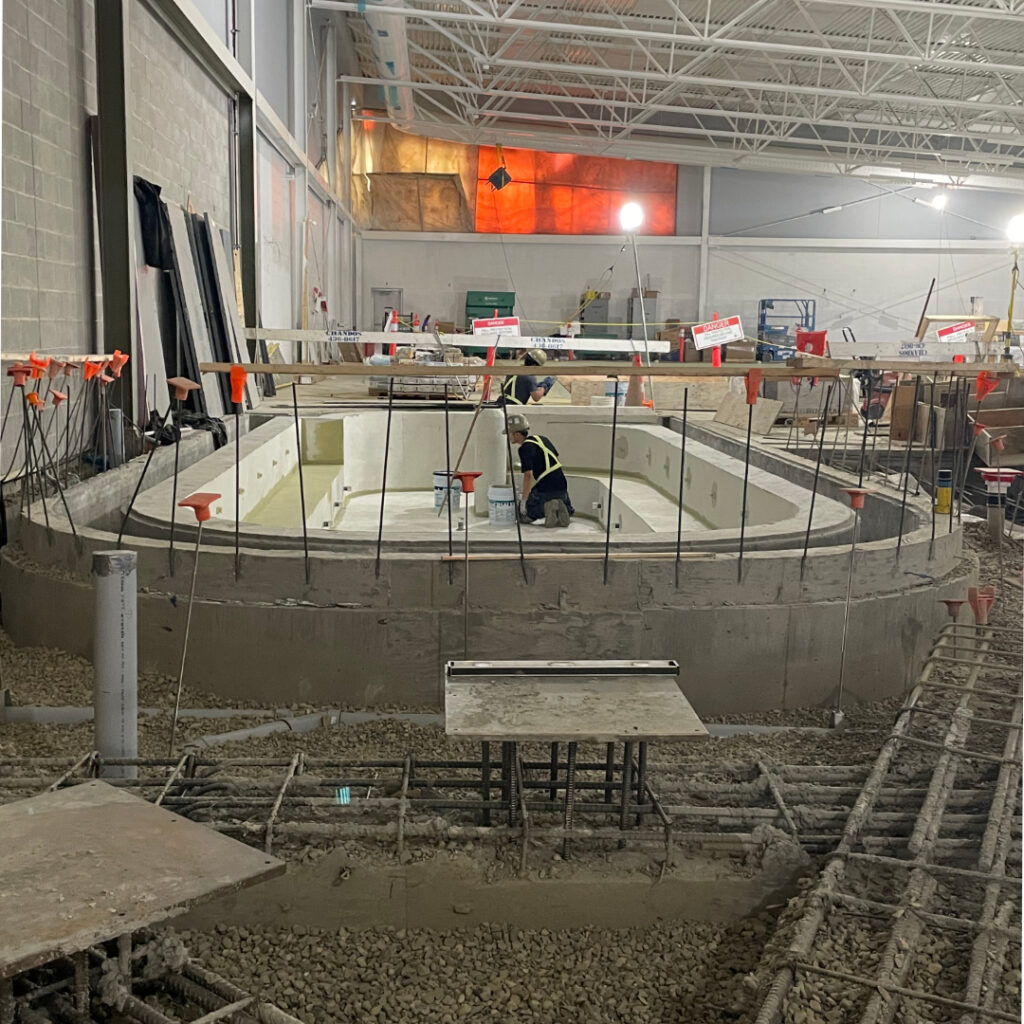
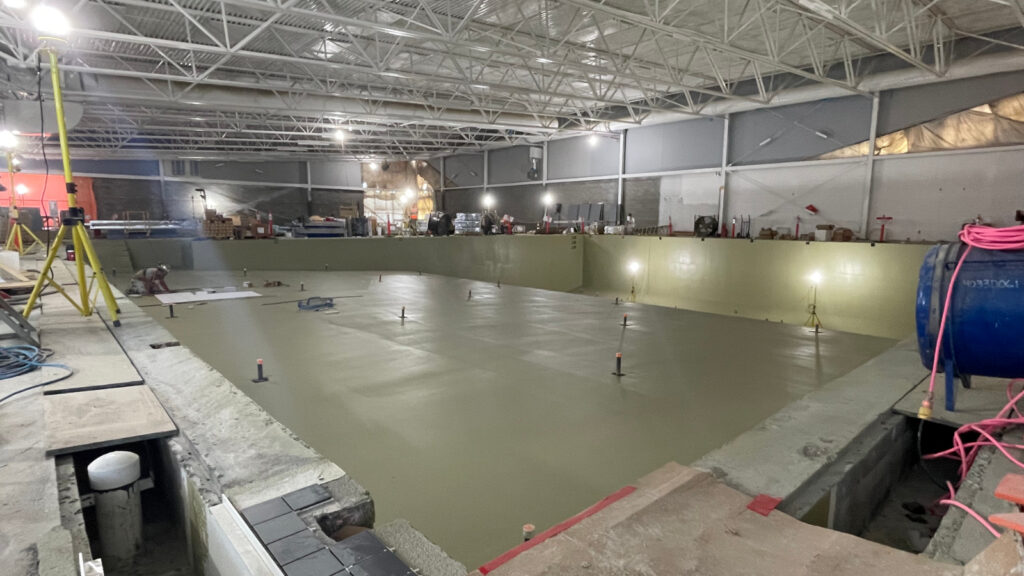
In the meantime, building work continues and the site is still very much an active construction zone. Last week workers were beginning to install tiling on the main pool. Hydrostatic testing was being carried out on the lazy river. That’s a process where components such as piping systems are tested for strength and leaks.

Living Spirit United Church
Everyone welcome. Sunday Worship, 10:30 We are residents of Drayton Valley, members and adherents of

Life Church Drayton Valley
We know that exploring a new church can be an overwhelming experience. To help you
Drayton Valley Alliance Church
Join us Sunday Mornings 10:30 am Everyone Welcome! Phone: 780-542-6501 Email: office@dvalliance.ca Mailing address: Box

Jaw’s Backhoe Service Ltd.
BACKHOE FOR HIRE Reasonable rates. Fully insured. Click Here Services Offered SEPTIC SYSTEM INSTALLATION NEW
All Saints Anglican Church
Drayton Valley, All Saints Anglican Church participates in the Anglican Liturgy, which comforts and sustains us. Many have said that in such a busy and changing world it is important to come to a place that feels like home.
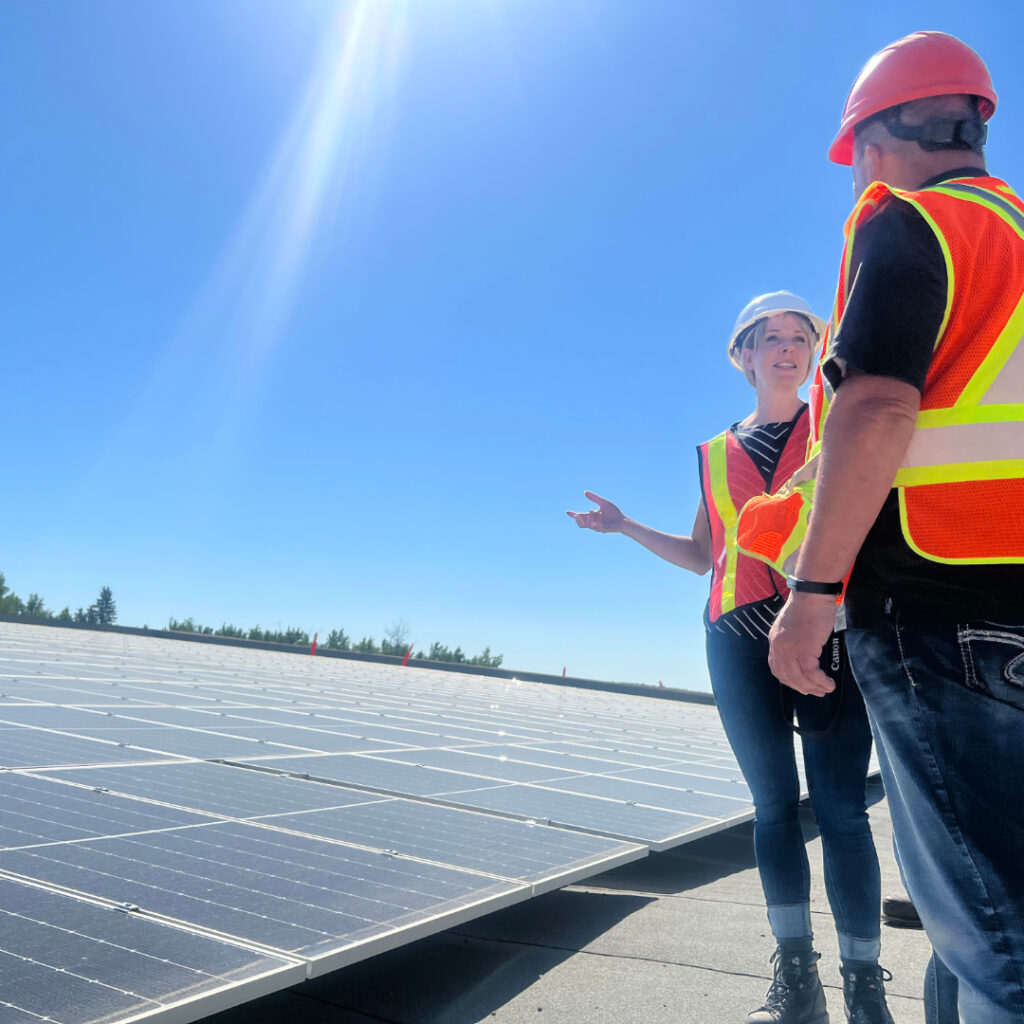
The roof of the Aquatic Centre is complete, and features an array of 634 solar panels capable of generating 300 kw at peak times. Those panels are part of a larger initiative to attempt to limit the facility’s operating costs. Other steps taken include a building envelope that has been upgraded with a thermally broken curtain wall system. All windows will have double pane glazing, and all basins, showers, water closets, sinks, and toilets will utilize low flow technology. Continuous gutters and surge tanks will alleviate water waste due to splash out.
Once complete the Ricochet Oil Corp. Aquatic Centre will feature a 25 metre, eight lane lap pool that’s deep enough for diving, along with a leisure pool with a slide and a lazy river with multiple spray features. There will also be a multi-purpose room, a steam room and a hot tub. It will replace the existing Park Valley Pool, which was built in 1985.
Work on the Aquatic Centre began in early 2021, with a budgeted cost just shy of $22 million. That money came in the form of $5 million each from Brazeau County and the Town of Drayton Valley and a $7.5 million grant from the federal government. The balance was raised through smaller grants and a number of corporate donations and sponsorships.
Last Friday, the community celebrated the grand opening of the Northern Lakes College mobile trade unit, a milestone that has been in the works for a decade.
“What an exciting day this is for Drayton Valley and for our region,” said Mayor Nancy Dodds. “I can’t believe we’re here celebrating the official opening of the Northern Lakes College mobile trades unit. It’s been a long time coming.”
The 1,500 square foot unit was filled with delegates from Northern Lakes College, University of Alberta, the province, and the Town and County. Instructors, current students and their families were also present for the occasion.
“Today’s ribbon cutting is about much more than a mobile training lab,” said Minister of Advanced Education Myles McDougall. “It’s about bringing accredited education closer to people in the communities it serves.”
Education and youth retention were two motivating factors for the Town when it began advocating for post-secondary institute partnerships. They felt that rural students deserved to be able to live with their families and save on expenses while pursuing a higher education, which wasn’t possible if they had to move to a larger centre to attend classes.
“This mobile trades lab brings the training to the learner,” said McDougall. “It means people can build skills for a rewarding career in the trades without leaving the community they are proud to call home.”


Over the years, post-secondary educational opportunities have grown in the community. However, there were still no schooling opportunities for students who were interested in pursuing a career in trades. With the arrival of the mobile trades unit, that gap has been closed.
MLA Andrew Boitchenko said this unit will also have a ripple effect out to the businesses in the area because they will have access to a pool of skilled workers to work on their projects. “I come from a background of land development and construction, and I understand firsthand what it means to have available skilled workers to do the work,” he said.
Though youth retention was one of the motivations behind the unit, the training lab will also be beneficial for adults who are transitioning careers. Rather than driving into the city for training, or leaving their families for months at a time, they can now begin a new career and stay at home.
Starting at the beginning of September, several students began working on a carpentry program that will give them an introduction into the trade. At the end of the semester, if they pass, they will be registered apprentices and can begin their careers in the field.
“It’s only here for one year right now, but I’m hoping, and I can visualize it, for it to be here for decades to come because there is so many people in Drayton Valley that could benefit from it,” he said..
The trades unit also offers an economical way to offer education in rural communities. With a mobile unit, the province and municipalities don’t need to invest in building facilities that can offer these courses. Instead, they can just show a need in the community and request that a unit be sent out to offer the education.
Dodds said industry partnerships are also helpful for the project. A local business donated $10,000 to the tuition assistance bursary grant specifically for students participating in training at the mobile unit.

“Your investment goes beyond funding,” said Dodds. “It’s an investment in our people, in our programs, in our community, and in our region, so thank you so much for your generosity.”
Dodds also acknowledged the partnership the Town has had with Northern Lakes College over the past several years.
“You have been a pillar and an advocate, and a strong voice at the table with us for many years. You believed in the programs that we believed in; you believed in the needs of rural communities like your own. So, thank you for being here today. Without you, we wouldn’t be standing here today. We would never have created this opportunity,” said Dodds.
President and CEO of Northern Lakes College, Dr. Glenn Mitchell, said they wanted to get education opportunities out to everyone in the province.
“It is an innovative response to a very real challenge. How do we make post-secondary education more accessible to learners regardless of where they live?” he said. “We believe geography should never be a barrier to education.”
During his time at the mobile trades unit, Mitchell had the opportunity to meet with some of the students and said he was looking forward to working with them.
“To the students… You’re here in this space, this opportunity; it’s all about you. It’s for you. We look forward to supporting you as you build your new skills and pursue your goals, and prepare for successful, meaningful careers.”



Life moves pretty fast. Later this week it will be 25 years to the day since I was woken up by a phone call from a friend telling me to turn on the television because “they are crashing planes into the World Trade Centre.”
I did what any sensible person would do and rolled over and went back to sleep after resolving to change my phone number.
When I did get up, exactly 15 minutes before I was due at work, I discovered that I had snoozed and snored my way through a good chunk of one of the great tragedies of the 21st Century.
There has been a lot of water under the bridge since September 11 2001, much of it murky.
When I got to work that Tuesday morning I found that someone had brought a portable television to the office. This was at the Western Review and not everyone had access to the internet, which was still relatively new. So we watched together as the news reports – often contradictory– filtered through.
Back then New York and Washington seemed a long way from Drayton Valley. They still do. But this was an event of such magnitude that, for a while at least, the world suddenly seemed like a much smaller place. Much smaller and quite a bit scarier.
Before 9/11 Canadians thought terror attacks were the kind of thing that only happened to other people. After 9/11 Canadians still thought terror attacks were the kind of thing that only happened to other people, but worryingly, some of those people looked a lot like us.
There’s a bit of a theme here. Back in 2001 there was a lot of concern over further attacks from overseas. But as it turned out, almost all of the terrorism we have seen in North America over the last couple of decades did not come from overseas. It’s come from right here at home and has been carried out by people who (guess what) look a lot like us.
Here in Drayton Valley I knew one person who was so moved by the scale of the suffering on 9/11 that they resolved to get their own life in order and quit drinking and gambling. He said he’d come to realize how precious life was, and was determined not to just piss his away. I ran into him again in the old bar a few years ago and, well, it looked like things hadn’t gone exactly to plan. But the fact he even made the effort goes some way to reflect the impact 9/11 had even in this corner of Alberta.
And it wasn’t just him. A local singer got together with some friends and recorded a song dedicated to the people of New York. Flags were lowered. Prayers were said.
In the weeks that followed it became a popular notion that the 9/11 attacks had changed the world. A quarter of a century later that still feels like a fair assessment.
The planet feels like a darker, more paranoid place than it did before the attacks. We’ve become more suspicious, particularly of people who don’t look exactly like us or think the way we do.
Conspiracy theories existed before 2001, most notably surrounding the assassination of President John F Kennedy. But it was 9/11 that really brought that kind of thinking to the foreground. Perhaps people didn’t want to believe that a small group of fanatical nutcases could pull off such an outrageous act unassisted and looked around for someone else to blame.
But whatever the cause, in the months and years since 9/11 we have seen exponential growth in belief in conspiracies and the associated damage such belief does to our society.
That kind of thinking has led to a loss of trust in institutions ranging from the federal government to the traditional media. It’s become popular to dismiss the work of experts in any field as in some way tainted, simply by virtue of that expertise.
And that in turn has led us to the world we see today, where facts seem to be flexible and everyone has their own version of the truth.
The 9/11 attacks may not have succeeded in their initial aim of bringing America to its knees. But if the broader target was to damage western institutions and make North America a worse place to live … well, here we are.
The K-9 students at the Tomahawk School have been getting a hands-on learning experience with farming through an agricultural program.
“We’re actually heading into our third year of offering a rural and agricultural education program here at Tomahawk School,” says school principal Tracey Gilmour.
The program was started after the Parkland School Division held a west-end community stakeholder engagement meeting. Gilmour says they heard from parents in their area that they would like to see more practical, hands-on learning, career education, and programming that focused on rural lifestyles.
“It’s brand new for Parkland School Division,” says Gilmour. “There are a couple around the province. One is a charter school, so that’s a little bit different, and then we know of one, maybe two, others.”
Gilmour says they’ve integrated the program into the school curriculum and students get hands-on experience.
“All of our students from K-9 do participate in that class,” says Gilmour.
She says the school views it as a careers education class because many of the students live locally and their families have been in the area for generations.
“We very much see it, as a school, as our responsibility to help prepare our students so that if they also want to continue living in a rural setting, for careers so that they can be successful in a rural community,” she says.
She says the program touches on many areas so students are learning skills that could help in a variety of different careers. This includes fish and wildlife, cottage industries, and they may even branch into oil and gas.
“We’re looking to run programs that can fit that mandate locally,” she says.
Over the past two years, the school has been developing a school farm with the help of some grants and parent volunteers.
“We introduced chickens as our first project,” she says.
Currently, they have a beekeeping program, raised bed gardens, and are putting in a crop field so students can learn how that works.
“We’re also about to get a barn installed in October, hopefully,” says Gilmour. “And at that point we’ll be looking at some larger livestock with some sheep, maybe goats, and then who knows from there.”
Gilmour says they are also applying for some grants for a building that will allow them to offer a year-round hydroponic garden.
The type of classes the students take is based on their age. For the younger children, they spend a lot of time learning outdoors and in nature. She says they spend a lot of time in the forest, learn about local wildlife and animals, and were involved with the chicken hatching.
“One of the things that we know from research is that if we’re going to ask our future generations to be stewards of the land, well, first they have to be connected to that land and love that land,” says Gilmour.
Junior high students who have parent permission are doing hands-on beekeeping. The older students also get to learn about the business side of farming. Gilmour says they learn about business planning, developing land, choosing which produce and livestock to work with , and other aspects of farming that don’t require as much physical labour.
“It really is a tiered approach, like we feel is most age-appropriate and how hands-on they can be on the farm,” she says.
They also focus on technology in the industry. One of the career classes they are offering this year is drone piloting because many crops are now being sprayed using drones.
“We know as a rural career there are lots of opportunities there, whether it’s in utility corridor monitoring work, whether it’s photographing, surveying, or even if it is in agricultural spraying,” she says.
Not only do the students get to participate in the program, but those that show interest beyond the day-to-day class can apply for different roles such as poultry manager or apiary manager. The younger students can also take on extra roles by applying to be a helper.
The students who take on these roles are responsible for managing the chickens and the bees during the school year.
For the first year of the program, the school relied on volunteers to help keep the farm running over the summer. However, this last summer, they offered a high school credit program in July to bring in high school students to help look after things over the summer.
As Tomahawk School does not have high school students, they opened it up to any high school students who would like to earn some extra credits.
“For two weeks over the summer, any high school student, it doesn’t matter what school division they belong to, they could sign up for a credit program,” says Gilmour.
here were several courses the students took, including agricultural safety, introduction to agriculture, introduction to animal basics, introduction to animal husbandry, a livestock course, among others.
She says there were a number of students who signed up, and all of them received six credits for completing the courses. Some of those summer students had just finished junior high and are now heading into high school with credits.
“They were very hands-on with the farm,” says Gilmour. “We did have the sheep in at that time, as well… We brought in some meat rabbits as well.”
On top of that, the school has hatched their own chickens and raised trout for the local fishing ponds.
One of the reasons the school was chosen for this program is Gilmour’s experience in alternative programming. She stepped into the role of principal two years ago, and when she saw the results of the stakeholder meeting, she put together a proposal for the program.
“The division accepted that proposal, and we’ve had the green light ever since to push this as far as we can to see what we can do to set these children up for success in their rural communities,” says Gilmour.
She says they are hoping to find more people who want to be involved, not necessarily with a time commitment, but with expertise and advice. Last year, the school had an expert in maple-tapping teach the kids about the process.
“We are always on the lookout for more community support,” she says.
She says the parents have been very helpful. They were involved in repurposing a shed into a chicken coop, building temporary shelters, fencing, and one volunteer brought in a tractor to create the crop field.
“There is a lot of community involvement in that sense, as well,” says Gilmour.
She says they are always looking for feedback from parents. They currently have a survey linked on their social media page to ascertain if there is a need or want for a high school program.
“We’re looking at a blended high school program potentially,” says Gilmour.
Students would be able to do their core subjects through Parkland School Division’s online learning program, Connection for Education. In the afternoons, they would then focus on the rural and agricultural learning program.
She says they are still open to enrolment, even for students who are not within the catchment area of the Tomahawk School. Parents from other areas can enrol their students with the understanding that they would have to transport their child to the school.
“You don’t have to live in Tomahawk to go to this school,” says Gilmour.
If you’re a teacher who has just headed back to school I have some bad news. Facebook says you’ve been doing it wrong. Or, to be more specific, you’ve been teaching the wrong stuff.
According to something I read on the social media platform, the education system is teaching kids the wrong subjects. And it has been for years.
Facebook obviously wouldn’t just allow someone to publish something without rigorous fact checking. That would be grossly irresponsible. So we have to assume there’s a degree of existential truth to the list of Subjects that Should Be Mandatory in Schools, but I’m not sure what.
I won’t bore you with the full rundown but it includes things like home maintenance, insurance, coding, balancing a cheque book and public speaking.
Wait, what?
Balancing a cheque book was an important skill back around 1990. These days it’s as much use as knowing how to change a roll of fax paper or memorizing your best friend’s phone number.
Keeping up with home repairs is a great thing and you’ll save a bunch of money if you can do them yourself, but as a subject it’s a little vague. Are we talking about changing a lightbulb or pouring a concrete slab for your deck? It would be good to know because one of these things is not like the other.
Insurance? I don’t even know what that means. Sure it can be an expensive mistake if you wind up overinsured. And it can be an even more expensive mistake if you wind up under insured. But I’m not clear on how they’re supposed to teach that in schools when there are so many variables and every case is going to be different.
Coding would be a very worthwhile skill in an increasingly computerized world, but I’m not sure it’s something we all need to be good at, the same as we don’t all need to be doctors, airline pilots or electricians.
And public speaking? Well, don’t schools already teach that? Isn’t that the point of every presentation you were asked to make in front of the class from Grade 1 show and tell onwards?
So if I was a teacher I’d ignore what Facebook says and stick to what I’m doing. You see a lot of criticisms of the high school curriculum, but the standard, traditional subjects have stood us in good stead. Sure, you don’t necessarily end up using everything they teach you in school once you enter the real world. After almost fifty years I’m still waiting for a Frenchman to approach me on the street, say “bonjour” and ask me how old I am or what the time is, but I’ll certainly be prepared if it ever happens.
And the other stuff, reading, writing and arithmetic, is still as important as it ever was. Yeah, we all carry a calculator with us these days, but if you’re trying to figure out whether 600 grams of cheese for $7.22 is a better deal than 450 grams for $5.07, you still have to know how to ask the question before your phone can give you the answer.
Teaching things like that is what school’s for. I hope that never changes.
A local woman has made it to the top after losing the most weight and was named the TOPS Queen for 2026.
Seventy-eight-year-old Pat Thoreson has been a member of the not-for-profit weight-loss club, Take Off Pounds Sensibly, since 1984. After losing the most weight in Alberta this year, Thoreson was crowned the TOPS Queen last May.
“I started out with a weight problem when I was growing up, so I’ve spent a lot of years at it,” she says.
Since she joined TOPS, Thoreson has lost 72.25 lbs, though she says most of the loss was over the past couple of years.
Prior to joining TOPS, Thoreson had tried out a number of different groups in an attempt to achieve results, but with little success. She says she would lose a little bit of weight, but then would gain it back.
Living near Winfield, Thoreson would meet with the club in Bluffton. From spring to the fall, Thoreson would drive herself to the club every week. Over the winter, Thoreson’s husband would drive her so she wouldn’t have to drive in the dark.
As much as the group was about losing weight, the social aspect was also appealing. She says the club was extremely supportive, and she formed a bond with the members, which was one of the reasons that kept her motivated to return.


“We take turns doing programs, and we have contests. It’s just a good support club,” she says. “That has been another thing that has gotten me to this point.”
One of the women Thoreson met was Violet Schmidt, who was Queen in 1995, and the two became very close.
“Over the years, she was one of the best supporters that I’ve ever had,” she says.
Unlike other groups, Thoreson found the approach of TOPS refreshing. Each week there was a weigh-in for the members, similar to other organizations, but they focused on making healthy food choices rather than food or calorie restriction.
“It’s a food exchange,” says Thoreson. “It’s not that you can’t eat certain foods; you just think about the amount of calories and that type of thing.”
She says they allow themselves to eat the food, but just remain conscious of how much and how often they ate it.
It’s also cheaper than many other programs. To join TOPS, there is an annual fee of $49 USD. Thoreson says her club, which has since relocated to Hoadley, also charges a $5 fee for each meeting to cover the costs of the coffee and rental space. Other than that, there are no fees for information packages and no meals that have to be purchased.
Thoreson says the biggest weight loss came after she received an award for being part of the club for 40 years.
“I thought, ‘40 years and I haven’t really done a whole bunch,’” she says. “That’s one of the things that kind of shook my memory that this was why I was really here, not just to visit.”
She says she lost weight at a healthy pace and was able to keep it off thanks to the information she had from the group and the exercise regime that she stuck to.
“On Mondays, [my husband and I] would floor curl in the afternoon. Then on Tuesdays and Thursdays I do chair exercises for one hour in Buck Lake on Tuesdays and Winfield on Thursdays. Then on Thursdays I would walk for three-quarters to an hour at Winfield as well,” says Thoreson.
As a Queen, Thoreson says she would like to advocate the importance of healthy choices to people.
“A person can do it if they just stop and think about what they’re eating and what they should be eating,” she says. “Even though it took me 42 years, I still go there. It’s not like you have to do it all of a sudden.”
Thoreson says she hopes people will hear her message and make time to attend a meeting at a nearby club to see what the organization is all about.
More information about the program can be found at www.tops.org.
I remember when I let my kids walk to school alone for the first time. I stood in our big front window waving, and blowing kisses fighting the urge to jump in my car and follow them. I told myself repeatedly that if I didn’t get a call from the school wondering where they were, they must have made it safely and they did.
The route to school from our home on 54th Ave was pretty calm for the most part except for three crossings. The first was crossing the road that the old pool was on from west to east. There was no cross walk and it had some blind spots. People often picked up speed while driving and I would really hammer it into the kids’ heads “Stop, look and listen! Then get eye contact.” The other two crossings closer to St. Anthony School did have traffic lights, however some drivers liked to make that right hand turn while they were looking left. Again “Eye contact!” I wanted my kids to know the responsibility of being a pedestrian, after all we lived in town and walking was something we did often. I never wanted them to implicitly trust that the driver saw them, or wasn’t distracted. They needed to be predictable and patient for drivers. That first walk happened three years ago and my, how times have changed.
Whereas, before I directed much of my annoyance and outrage at drivers, now it’s the “pedestrians,” who aren’t actually on foot. I’m talking about people on an e-anything who zip and zoom from sidewalk to the roads, and who don’t make eye contact, don’t act predictably and generally are not respecting the rules of the road or the sidewalk.
Do I sound like a Karen? I hope so.
A few weeks ago I was walking to the library from the office, and there was a truck at the fourway stop to my right. I made eye contact, looked both ways and proceeded to walk. Then out of the blue to my left, an electric scooter came off the sidewalk onto the road, cut off my path of walking and zipped through the intersection, without stopping thereby cutting the truck off too. In this one instance not only could the person have hit me, but the truck that was ready to proceed could have gunned it and hit him.
Seinfeld is my mindless pleasure. There’s one episode I just watched where Kramer got into blows with a baseball player over a ball cleaning violation on the golf course. Jerry thought he was being too strict with the rules. Kramer’s response. “Hey, a rule is a rule and let’s face it without rules…there’s chaos.” This is what the roadways and sidewalks seemed to have devolved into, utter chaos.
So despite the fact that the current laws on electric anything are murky, and scooters shouldn’t be used off of private property, here they are. And while I would love to deliver the typical PSA to drivers, that says “Hey it is back to school, please watch out for pedestrians.” I also want to shout out. “Hey it’s back to school, please make sure your kids know the rules of the road, how to be a respectful pedestrian that acts in a predictable manner around vehicles, and non-motorized pedestrians! Please!!! For the love of…”
I am not just being a Karen on this one and I would like to put the general reminder that not more than a few years ago we had an e-scooter death in this very town when a scooter driver hit a pedestrian, knocking him down resulting in injury causing death.
So on one hand I would like all drivers to be aware of the pedestrians out on the sidewalk this school season but also, pedestrians or hybrid pedestrians please also do your due diligence and watch for traffic, and be predictable. Lets make sure everyone gets to where they are going in a boring and uneventful way this school year.
It’s anticipated that the new facility will attract around 116,000 users per year, compared to 86,000 for the Park Valley Pool. Drop in user fees for the Aquatic Centre have been set at $9.85 for an adult, $7.85 for student or a senior and $6.85 for a child under the age of eight. Passes and punch cards will be offered at a lower rate.
Last Friday, the community celebrated the grand opening of the Northern Lakes College mobile trade unit, a milestone that has been in the works for a decade.
“What an exciting day this is for Drayton Valley and for our region,” said Mayor Nancy Dodds. “I can’t believe we’re here celebrating the official opening of the Northern Lakes College mobile trades unit. It’s been a long time coming.”
The 1,500 square foot unit was filled with delegates from Northern Lakes College, University of Alberta, the province, and the Town and County. Instructors, current students and their families were also present for the occasion.
“Today’s ribbon cutting is about much more than a mobile training lab,” said Minister of Advanced Education Myles McDougall. “It’s about bringing accredited education closer to people in the communities it serves.”
Education and youth retention were two motivating factors for the Town when it began advocating for post-secondary institute partnerships. They felt that rural students deserved to be able to live with their families and save on expenses while pursuing a higher education, which wasn’t possible if they had to move to a larger centre to attend classes.
“This mobile trades lab brings the training to the learner,” said McDougall. “It means people can build skills for a rewarding career in the trades without leaving the community they are proud to call home.”


Over the years, post-secondary educational opportunities have grown in the community. However, there were still no schooling opportunities for students who were interested in pursuing a career in trades. With the arrival of the mobile trades unit, that gap has been closed.
MLA Andrew Boitchenko said this unit will also have a ripple effect out to the businesses in the area because they will have access to a pool of skilled workers to work on their projects. “I come from a background of land development and construction, and I understand firsthand what it means to have available skilled workers to do the work,” he said.
Though youth retention was one of the motivations behind the unit, the training lab will also be beneficial for adults who are transitioning careers. Rather than driving into the city for training, or leaving their families for months at a time, they can now begin a new career and stay at home.
Starting at the beginning of September, several students began working on a carpentry program that will give them an introduction into the trade. At the end of the semester, if they pass, they will be registered apprentices and can begin their careers in the field.
“It’s only here for one year right now, but I’m hoping, and I can visualize it, for it to be here for decades to come because there is so many people in Drayton Valley that could benefit from it,” he said..
The trades unit also offers an economical way to offer education in rural communities. With a mobile unit, the province and municipalities don’t need to invest in building facilities that can offer these courses. Instead, they can just show a need in the community and request that a unit be sent out to offer the education.
Dodds said industry partnerships are also helpful for the project. A local business donated $10,000 to the tuition assistance bursary grant specifically for students participating in training at the mobile unit.
“Your investment goes beyond funding,” said Dodds. “It’s an investment in our people, in our programs, in our community, and in our region, so thank you so much for your generosity.”
Dodds also acknowledged the partnership the Town has had with Northern Lakes College over the past several years.
“You have been a pillar and an advocate, and a strong voice at the table with us for many years. You believed in the programs that we believed in; you believed in the needs of rural communities like your own. So, thank you for being here today. Without you, we wouldn’t be standing here today. We would never have created this opportunity,” said Dodds.
President and CEO of Northern Lakes College, Dr. Glenn Mitchell, said they wanted to get education opportunities out to everyone in the province.
“It is an innovative response to a very real challenge. How do we make post-secondary education more accessible to learners regardless of where they live?” he said. “We believe geography should never be a barrier to education.”
During his time at the mobile trades unit, Mitchell had the opportunity to meet with some of the students and said he was looking forward to working with them.
“To the students… You’re here in this space, this opportunity; it’s all about you. It’s for you. We look forward to supporting you as you build your new skills and pursue your goals, and prepare for successful, meaningful careers.”
Life moves pretty fast. Later this week it will be 25 years to the day since I was woken up by a phone call from a friend telling me to turn on the television because “they are crashing planes into the World Trade Centre.”
I did what any sensible person would do and rolled over and went back to sleep after resolving to change my phone number.
When I did get up, exactly 15 minutes before I was due at work, I discovered that I had snoozed and snored my way through a good chunk of one of the great tragedies of the 21st Century.
There has been a lot of water under the bridge since September 11 2001, much of it murky.
When I got to work that Tuesday morning I found that someone had brought a portable television to the office. This was at the Western Review and not everyone had access to the internet, which was still relatively new. So we watched together as the news reports – often contradictory– filtered through.
Back then New York and Washington seemed a long way from Drayton Valley. They still do. But this was an event of such magnitude that, for a while at least, the world suddenly seemed like a much smaller place. Much smaller and quite a bit scarier.
Before 9/11 Canadians thought terror attacks were the kind of thing that only happened to other people. After 9/11 Canadians still thought terror attacks were the kind of thing that only happened to other people, but worryingly, some of those people looked a lot like us.
There’s a bit of a theme here. Back in 2001 there was a lot of concern over further attacks from overseas. But as it turned out, almost all of the terrorism we have seen in North America over the last couple of decades did not come from overseas. It’s come from right here at home and has been carried out by people who (guess what) look a lot like us.
Here in Drayton Valley I knew one person who was so moved by the scale of the suffering on 9/11 that they resolved to get their own life in order and quit drinking and gambling. He said he’d come to realize how precious life was, and was determined not to just piss his away. I ran into him again in the old bar a few years ago and, well, it looked like things hadn’t gone exactly to plan. But the fact he even made the effort goes some way to reflect the impact 9/11 had even in this corner of Alberta.
And it wasn’t just him. A local singer got together with some friends and recorded a song dedicated to the people of New York. Flags were lowered. Prayers were said.
In the weeks that followed it became a popular notion that the 9/11 attacks had changed the world. A quarter of a century later that still feels like a fair assessment.
The planet feels like a darker, more paranoid place than it did before the attacks. We’ve become more suspicious, particularly of people who don’t look exactly like us or think the way we do.
Conspiracy theories existed before 2001, most notably surrounding the assassination of President John F Kennedy. But it was 9/11 that really brought that kind of thinking to the foreground. Perhaps people didn’t want to believe that a small group of fanatical nutcases could pull off such an outrageous act unassisted and looked around for someone else to blame.
But whatever the cause, in the months and years since 9/11 we have seen exponential growth in belief in conspiracies and the associated damage such belief does to our society.
That kind of thinking has led to a loss of trust in institutions ranging from the federal government to the traditional media. It’s become popular to dismiss the work of experts in any field as in some way tainted, simply by virtue of that expertise.
And that in turn has led us to the world we see today, where facts seem to be flexible and everyone has their own version of the truth.
The 9/11 attacks may not have succeeded in their initial aim of bringing America to its knees. But if the broader target was to damage western institutions and make North America a worse place to live … well, here we are.
The K-9 students at the Tomahawk School have been getting a hands-on learning experience with farming through an agricultural program.
“We’re actually heading into our third year of offering a rural and agricultural education program here at Tomahawk School,” says school principal Tracey Gilmour.
The program was started after the Parkland School Division held a west-end community stakeholder engagement meeting. Gilmour says they heard from parents in their area that they would like to see more practical, hands-on learning, career education, and programming that focused on rural lifestyles.
“It’s brand new for Parkland School Division,” says Gilmour. “There are a couple around the province. One is a charter school, so that’s a little bit different, and then we know of one, maybe two, others.”
Gilmour says they’ve integrated the program into the school curriculum and students get hands-on experience.
“All of our students from K-9 do participate in that class,” says Gilmour.
She says the school views it as a careers education class because many of the students live locally and their families have been in the area for generations.
“We very much see it, as a school, as our responsibility to help prepare our students so that if they also want to continue living in a rural setting, for careers so that they can be successful in a rural community,” she says.
She says the program touches on many areas so students are learning skills that could help in a variety of different careers. This includes fish and wildlife, cottage industries, and they may even branch into oil and gas.
“We’re looking to run programs that can fit that mandate locally,” she says.
Over the past two years, the school has been developing a school farm with the help of some grants and parent volunteers.
“We introduced chickens as our first project,” she says.
Currently, they have a beekeeping program, raised bed gardens, and are putting in a crop field so students can learn how that works.
“We’re also about to get a barn installed in October, hopefully,” says Gilmour. “And at that point we’ll be looking at some larger livestock with some sheep, maybe goats, and then who knows from there.”

Gilmour says they are also applying for some grants for a building that will allow them to offer a year-round hydroponic garden.
The type of classes the students take is based on their age. For the younger children, they spend a lot of time learning outdoors and in nature. She says they spend a lot of time in the forest, learn about local wildlife and animals, and were involved with the chicken hatching.
“One of the things that we know from research is that if we’re going to ask our future generations to be stewards of the land, well, first they have to be connected to that land and love that land,” says Gilmour.
Junior high students who have parent permission are doing hands-on beekeeping. The older students also get to learn about the business side of farming. Gilmour says they learn about business planning, developing land, choosing which produce and livestock to work with , and other aspects of farming that don’t require as much physical labour.
“It really is a tiered approach, like we feel is most age-appropriate and how hands-on they can be on the farm,” she says.
They also focus on technology in the industry. One of the career classes they are offering this year is drone piloting because many crops are now being sprayed using drones.
“We know as a rural career there are lots of opportunities there, whether it’s in utility corridor monitoring work, whether it’s photographing, surveying, or even if it is in agricultural spraying,” she says.
Not only do the students get to participate in the program, but those that show interest beyond the day-to-day class can apply for different roles such as poultry manager or apiary manager. The younger students can also take on extra roles by applying to be a helper.
The students who take on these roles are responsible for managing the chickens and the bees during the school year.
For the first year of the program, the school relied on volunteers to help keep the farm running over the summer. However, this last summer, they offered a high school credit program in July to bring in high school students to help look after things over the summer.
As Tomahawk School does not have high school students, they opened it up to any high school students who would like to earn some extra credits.
“For two weeks over the summer, any high school student, it doesn’t matter what school division they belong to, they could sign up for a credit program,” says Gilmour.
here were several courses the students took, including agricultural safety, introduction to agriculture, introduction to animal basics, introduction to animal husbandry, a livestock course, among others.
She says there were a number of students who signed up, and all of them received six credits for completing the courses. Some of those summer students had just finished junior high and are now heading into high school with credits.
“They were very hands-on with the farm,” says Gilmour. “We did have the sheep in at that time, as well… We brought in some meat rabbits as well.”
On top of that, the school has hatched their own chickens and raised trout for the local fishing ponds.
One of the reasons the school was chosen for this program is Gilmour’s experience in alternative programming. She stepped into the role of principal two years ago, and when she saw the results of the stakeholder meeting, she put together a proposal for the program.
“The division accepted that proposal, and we’ve had the green light ever since to push this as far as we can to see what we can do to set these children up for success in their rural communities,” says Gilmour.
She says they are hoping to find more people who want to be involved, not necessarily with a time commitment, but with expertise and advice. Last year, the school had an expert in maple-tapping teach the kids about the process.
“We are always on the lookout for more community support,” she says.
She says the parents have been very helpful. They were involved in repurposing a shed into a chicken coop, building temporary shelters, fencing, and one volunteer brought in a tractor to create the crop field.
“There is a lot of community involvement in that sense, as well,” says Gilmour.
She says they are always looking for feedback from parents. They currently have a survey linked on their social media page to ascertain if there is a need or want for a high school program.
“We’re looking at a blended high school program potentially,” says Gilmour.
Students would be able to do their core subjects through Parkland School Division’s online learning program, Connection for Education. In the afternoons, they would then focus on the rural and agricultural learning program.
She says they are still open to enrolment, even for students who are not within the catchment area of the Tomahawk School. Parents from other areas can enrol their students with the understanding that they would have to transport their child to the school.
“You don’t have to live in Tomahawk to go to this school,” says Gilmour.
If you’re a teacher who has just headed back to school I have some bad news. Facebook says you’ve been doing it wrong. Or, to be more specific, you’ve been teaching the wrong stuff.
According to something I read on the social media platform, the education system is teaching kids the wrong subjects. And it has been for years.
Facebook obviously wouldn’t just allow someone to publish something without rigorous fact checking. That would be grossly irresponsible. So we have to assume there’s a degree of existential truth to the list of Subjects that Should Be Mandatory in Schools, but I’m not sure what.
I won’t bore you with the full rundown but it includes things like home maintenance, insurance, coding, balancing a cheque book and public speaking.
Wait, what?
Balancing a cheque book was an important skill back around 1990. These days it’s as much use as knowing how to change a roll of fax paper or memorizing your best friend’s phone number.
Keeping up with home repairs is a great thing and you’ll save a bunch of money if you can do them yourself, but as a subject it’s a little vague. Are we talking about changing a lightbulb or pouring a concrete slab for your deck? It would be good to know because one of these things is not like the other.
Insurance? I don’t even know what that means. Sure it can be an expensive mistake if you wind up overinsured. And it can be an even more expensive mistake if you wind up under insured. But I’m not clear on how they’re supposed to teach that in schools when there are so many variables and every case is going to be different.
Coding would be a very worthwhile skill in an increasingly computerized world, but I’m not sure it’s something we all need to be good at, the same as we don’t all need to be doctors, airline pilots or electricians.
And public speaking? Well, don’t schools already teach that? Isn’t that the point of every presentation you were asked to make in front of the class from Grade 1 show and tell onwards?
So if I was a teacher I’d ignore what Facebook says and stick to what I’m doing. You see a lot of criticisms of the high school curriculum, but the standard, traditional subjects have stood us in good stead. Sure, you don’t necessarily end up using everything they teach you in school once you enter the real world. After almost fifty years I’m still waiting for a Frenchman to approach me on the street, say “bonjour” and ask me how old I am or what the time is, but I’ll certainly be prepared if it ever happens.
And the other stuff, reading, writing and arithmetic, is still as important as it ever was. Yeah, we all carry a calculator with us these days, but if you’re trying to figure out whether 600 grams of cheese for $7.22 is a better deal than 450 grams for $5.07, you still have to know how to ask the question before your phone can give you the answer.
Teaching things like that is what school’s for. I hope that never changes.
A local woman has made it to the top after losing the most weight and was named the TOPS Queen for 2026.
Seventy-eight-year-old Pat Thoreson has been a member of the not-for-profit weight-loss club, Take Off Pounds Sensibly, since 1984. After losing the most weight in Alberta this year, Thoreson was crowned the TOPS Queen last May.
“I started out with a weight problem when I was growing up, so I’ve spent a lot of years at it,” she says.
Since she joined TOPS, Thoreson has lost 72.25 lbs, though she says most of the loss was over the past couple of years.
Prior to joining TOPS, Thoreson had tried out a number of different groups in an attempt to achieve results, but with little success. She says she would lose a little bit of weight, but then would gain it back.
Living near Winfield, Thoreson would meet with the club in Bluffton. From spring to the fall, Thoreson would drive herself to the club every week. Over the winter, Thoreson’s husband would drive her so she wouldn’t have to drive in the dark.
As much as the group was about losing weight, the social aspect was also appealing. She says the club was extremely supportive, and she formed a bond with the members, which was one of the reasons that kept her motivated to return.
“We take turns doing programs, and we have contests. It’s just a good support club,” she says. “That has been another thing that has gotten me to this point.”
One of the women Thoreson met was Violet Schmidt, who was Queen in 1995, and the two became very close.
“Over the years, she was one of the best supporters that I’ve ever had,” she says.
Unlike other groups, Thoreson found the approach of TOPS refreshing. Each week there was a weigh-in for the members, similar to other organizations, but they focused on making healthy food choices rather than food or calorie restriction.
“It’s a food exchange,” says Thoreson. “It’s not that you can’t eat certain foods; you just think about the amount of calories and that type of thing.”
She says they allow themselves to eat the food, but just remain conscious of how much and how often they ate it.
It’s also cheaper than many other programs. To join TOPS, there is an annual fee of $49 USD. Thoreson says her club, which has since relocated to Hoadley, also charges a $5 fee for each meeting to cover the costs of the coffee and rental space. Other than that, there are no fees for information packages and no meals that have to be purchased.
Thoreson says the biggest weight loss came after she received an award for being part of the club for 40 years.
“I thought, ‘40 years and I haven’t really done a whole bunch,’” she says. “That’s one of the things that kind of shook my memory that this was why I was really here, not just to visit.”
She says she lost weight at a healthy pace and was able to keep it off thanks to the information she had from the group and the exercise regime that she stuck to.
“On Mondays, [my husband and I] would floor curl in the afternoon. Then on Tuesdays and Thursdays I do chair exercises for one hour in Buck Lake on Tuesdays and Winfield on Thursdays. Then on Thursdays I would walk for three-quarters to an hour at Winfield as well,” says Thoreson.
As a Queen, Thoreson says she would like to advocate the importance of healthy choices to people.
“A person can do it if they just stop and think about what they’re eating and what they should be eating,” she says. “Even though it took me 42 years, I still go there. It’s not like you have to do it all of a sudden.”
Thoreson says she hopes people will hear her message and make time to attend a meeting at a nearby club to see what the organization is all about.
More information about the program can be found at www.tops.org.
I remember when I let my kids walk to school alone for the first time. I stood in our big front window waving, and blowing kisses fighting the urge to jump in my car and follow them. I told myself repeatedly that if I didn’t get a call from the school wondering where they were, they must have made it safely and they did.
The route to school from our home on 54th Ave was pretty calm for the most part except for three crossings. The first was crossing the road that the old pool was on from west to east. There was no cross walk and it had some blind spots. People often picked up speed while driving and I would really hammer it into the kids’ heads “Stop, look and listen! Then get eye contact.” The other two crossings closer to St. Anthony School did have traffic lights, however some drivers liked to make that right hand turn while they were looking left. Again “Eye contact!” I wanted my kids to know the responsibility of being a pedestrian, after all we lived in town and walking was something we did often. I never wanted them to implicitly trust that the driver saw them, or wasn’t distracted. They needed to be predictable and patient for drivers. That first walk happened three years ago and my, how times have changed.
Whereas, before I directed much of my annoyance and outrage at drivers, now it’s the “pedestrians,” who aren’t actually on foot. I’m talking about people on an e-anything who zip and zoom from sidewalk to the roads, and who don’t make eye contact, don’t act predictably and generally are not respecting the rules of the road or the sidewalk.
Do I sound like a Karen? I hope so.
A few weeks ago I was walking to the library from the office, and there was a truck at the fourway stop to my right. I made eye contact, looked both ways and proceeded to walk. Then out of the blue to my left, an electric scooter came off the sidewalk onto the road, cut off my path of walking and zipped through the intersection, without stopping thereby cutting the truck off too. In this one instance not only could the person have hit me, but the truck that was ready to proceed could have gunned it and hit him.
Seinfeld is my mindless pleasure. There’s one episode I just watched where Kramer got into blows with a baseball player over a ball cleaning violation on the golf course. Jerry thought he was being too strict with the rules. Kramer’s response. “Hey, a rule is a rule and let’s face it without rules…there’s chaos.” This is what the roadways and sidewalks seemed to have devolved into, utter chaos.
So despite the fact that the current laws on electric anything are murky, and scooters shouldn’t be used off of private property, here they are. And while I would love to deliver the typical PSA to drivers, that says “Hey it is back to school, please watch out for pedestrians.” I also want to shout out. “Hey it’s back to school, please make sure your kids know the rules of the road, how to be a respectful pedestrian that acts in a predictable manner around vehicles, and non-motorized pedestrians! Please!!! For the love of…”
I am not just being a Karen on this one and I would like to put the general reminder that not more than a few years ago we had an e-scooter death in this very town when a scooter driver hit a pedestrian, knocking him down resulting in injury causing death.
So on one hand I would like all drivers to be aware of the pedestrians out on the sidewalk this school season but also, pedestrians or hybrid pedestrians please also do your due diligence and watch for traffic, and be predictable. Lets make sure everyone gets to where they are going in a boring and uneventful way this school year.
Mobile trades unit comes to community
Last Friday, the community celebrated the grand opening of the Northern Lakes College mobile trade unit, a milestone that has been in the works for a decade.
Looking back over 25 years
Life moves pretty fast. Later this week it will be 25 years to the day since I was woken up by a phone call from a friend telling me to turn on the television because “they are crashing planes into the World Trade Centre.”
Students learn agriculture hands on
The K-9 students at the Tomahawk School have been getting a hands-on learning experience with farming through an agricultural program.
Old standards still make sense
If you’re a teacher who has just headed back to school I have some bad news. Facebook says you’ve been doing it wrong. Or, to be more specific, you’ve been teaching the wrong stuff.